




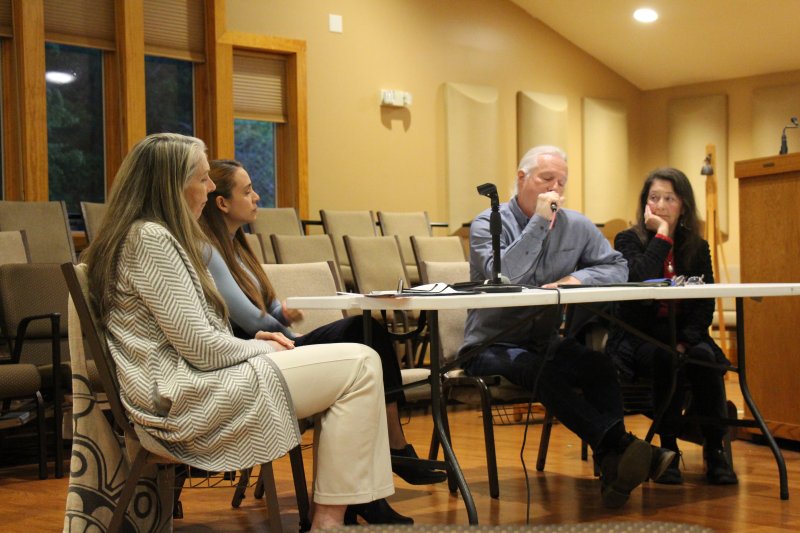
 A forum on the effects of the federal crackdown on undocumented immigrants was held April 27 at the Unitarian Universalist Church near Lewes. Shown are (l-r) Cait Clarke, co-founder of Sussex Help; Maydelis Gomez, who works for La Esperanza; Jack Dixon, support coordinator for Sussex Help; and Mary Dupont, co-founder of Sussex Help. KEVIN CONLON PHOTO
A forum on the effects of the federal crackdown on undocumented immigrants was held April 27 at the Unitarian Universalist Church near Lewes. Shown are (l-r) Cait Clarke, co-founder of Sussex Help; Maydelis Gomez, who works for La Esperanza; Jack Dixon, support coordinator for Sussex Help; and Mary Dupont, co-founder of Sussex Help. KEVIN CONLON PHOTO
A forum on the effects of the federal crackdown on undocumented immigrants was held April 27 at the Unitarian Universalist Church near Lewes. Shown are (l-r) Cait Clarke, co-founder of Sussex Help; Maydelis Gomez, who works for La Esperanza; Jack Dixon, support coordinator for Sussex Help; and Mary Dupont, co-founder of Sussex Help. KEVIN CONLON PHOTO
Editor’s note: This is the second story in an ongoing series about the controversial topic of immigration and how it's being handled in Sussex County.
Pastor Anastacio Matamoros has seen firsthand the consequences of the nationwide crackdown on undocumented immigrants in his Georgetown parish.
“As a pastor, I’m seeing, not only in my church but in the whole community, what is going on,” said Matamoros, who leads Iglesia de Dios de la Profecia. “In my church, we have already lost like six members. And one of the hardest things I have as a pastor is when I hear that someone has been taken.”
While men he speaks with after their arrest say they are tough and can handle it, the loss of a husband and father takes a heavy toll on families, Matamoros said.
“The hardest part is to go to that house and talk to that wife and talk to those kids,” he said. "They ask, ‘Where is my dad?' 'When is my dad coming home?' 'I don’t understand why my dad is not here.'”
Matamoros said he's been working with the community for the last 30 years. He said the Hispanic community has gone through a lot of challenges, but the current situation is one of the biggest.
The increased enforcement has resulted in significant changes to the methods used by U.S. Immigration and Customs Enforcement agents, resulting in many more arrests.
Figures for Sussex County alone are not available, but statewide there were 220 arrests reported in 2024, compared with 687 in 2025, according to the latest figures released by the Deportation Data Project.
The number of street arrests by ICE agents in Delaware increased from 24 in 2024 to 371 in 2025, according to the data.
Sussex Help co-founder Cait Clarke said those figures translate into many sad stories in Sussex County.
She said in one instance, both parents were taken by ICE, and their children were left behind. A single male neighbor took them in.
The loss is particularly profound and long-lasting in communities with large Latino and Haitian populations, she said. During an April 26 forum sponsored by Sussex Help, a woman going by the name Rachel recounted her experience 19 years ago when her father was deported.
“I was born here in Delaware to Guatemalan immigrants that came here for a better life, not just for them but for their children,” she said.
She remembers going to church on Sundays as a child, spending time with her family, a trip to Disney when she was 5. She remembers her father carrying her on his shoulders and the joy of watching the princesses come out of the castle.
“One night when I was 7, my dad did not show up,” Rachel said. “I kept on asking my mom where he was and how long he was going to take. My dad was rarely late from work.”
She later found out her father had been arrested by federal immigration officials.
“I realize that my name doesn’t matter,” Rachel said of the false name she gave at the event to protect her identity. “My name, you might not remember it after tonight, but what does matter is that you remember this story because this is the story of my first heartbreak.”
For many months, she cried every day and woke up at night crying and screaming.
“This is a trauma I would not wish on my worst enemy,” Rachel said. “While my experience is from many years ago, for the past year, all I can think about is how many people are having the same heartbreak.”
Sussex Help, which solicits donations to pay for rent and utility costs and daily expenses of families left behind while they decide their futures, has assisted 132 families with 184 children, said Jack Dixon, the group’s support coordinator.
“So if you think about every single family that lost their wage earner … mostly they’re taking working people who are working hard, paying taxes and supporting their families and trying to make a future,” he said. “So when they’re gone, there are mothers and children who have nothing.”
The effects are visible in several communities in Sussex County.
“Many undocumented people are afraid to walk the streets, attend church or have their children attend school,” said Bryant Garcia, executive director of La Esperanza, a Georgetown-based organization that provides legal assistance to immigrants.
“We have seen a significant dip in new [immigrant] students registering during the school year,” said Indian River School District spokesman David Maull.
Of the 10,700 students attending Indian River, 38% are Hispanic/Latino and just over 25% are English learners, Maull said.
While the numbers of immigrant students already enrolled have remained fairly steady, the number of students arriving each year from other countries has dropped sharply, he said. The figure had been about 650 annually, until it dropped to 407 in 2025 and 80 so far this year.
The decline in immigrant students has contributed to stunt Indian River’s rapid growth, which plateaued after the COVID-19 pandemic, Maull said. The district had projected enrollment to hit 12,000 this year.
Cape Henlopen School District, which has far fewer immigrant students, has not seen a noticeable decline in enrollment, said Assistant Superintendent LouAnn Hudson.
“We haven’t had much change in our numbers at all,” Hudson said.
She said 19% of district students are Hispanic/Latino and fewer than 10% of them are English learners.
The number of students with a foreign birth certificate entering Cape Henlopen schools was 57 in 2023-24; 54 in 2024-25; and 19 in 2025-26, Hudson said.
Indian River and Cape Henlopen have not had ICE agents come to the schools, officials said.
The effects of the ICE detentions across Sussex County are widespread, say local officials and groups that assist the families left behind.
“There is no consideration for the extended family, the fallout of that,” Dixon said. “[ICE is] focusing on getting this person out of the community. There is no concern for the family … You see the shock in their faces. Their whole lives are blown apart.”
The broader community may not see the implications of the immigration crackdown, but it is coming, Dixon said, noting many who are being deported are laborers whose skills are desperately needed in booming Sussex County.
“It’s going to affect us when it's time to fix a roof or a bathroom,” he said.
Bill West, the mayor of Georgetown, where about half the residents are immigrants, said he has seen a significant reduction in the number of immigrants out in the community.
“I’m hearing stories that they’re not sending their kids to school because they’re scared to death, and they’re not going into the restaurants and bars like they used to,” West said. “People are running scared ... They’re sending their kids or somebody to pick up their food.”
“Here in Sussex, there are so many Latinos and Haitians and other immigrants who are affected by ICE,” said the Rev. Cathy Rion Starr, an affiliated community minister for the Unitarian Universalist Church near Lewes.
“It is not visible to others outside that community,” Rion Starr added. “Those are the people who my kids go to school with. Those are the workers who staff the landscaping of all the HOAs around here.”
Maydelis Gomez emigrated from Cuba in 2019 to find freedom. She said at the April 26 forum that she became an American citizen in July 2024.
“A lot of your parents, grandparents, great-grandparents came here trying to reach the same thing that I did seven years ago – a better future for themselves and their future family,” said Gomez, who works for La Esperanza.
She said she felt welcome in Sussex County. But the feeling of security has eroded since the Trump administration cracked down on illegal immigration, even for those who have citizenship, Gomez said.
“I am all the time scared about what’s going to happen with me,” she said. “In case you didn’t notice, my first language is Spanish, so I am targeted for my language, if I speak. I’m not a white, blonde, blue-eyed person, so I’m targeted also for my color.”
A forum on the effects of the federal crackdown on undocumented immigrants was held April 27 at the Unitarian Universalist Church near Lewes. Shown are (l-r) Cait Clarke, co-founder of Sussex Help; Maydelis Gomez, who works for La Esperanza; Jack Dixon, support coordinator for Sussex Help; and Mary Dupont, co-founder of Sussex Help. KEVIN CONLON PHOTOEvent Details :
Premier Listing
Sponsored Content
















Premier Listing
Sponsored Content

Real Estate Marketplace
Sponsored Content


In the Market
Sponsored Content