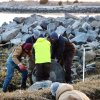













Sussex group uncovers mystery of Avery's Rest excavation
Many Delawareans may not know it, but often buried just a few feet below the surface of the grass at various local homes and other times only a few shovelfuls deep in neighborhood fields are mysterious artifacts from an unknown past.
Although the sites may be rare, there are a few locations in the state where thousands of objects have been recovered, giving historians a deep insight into what living in the state may have been like hundreds and even thousands of years in the past.
Almost by accident, one such site was discovered about three years ago, and since that time, a group of local archaeologists has had its collective hands full with a complete excavation of the site. It was only weeks ago that the team began discovering new, rare items from the fruitful locale – the virtual treasure trove of state history now known as Avery’s Rest.
Led by archaeologist Dan Griffith, the Sussex chapter of the Archeological Society of Delaware began probing the site in 2006. Located on a private residence a few miles from Route 1 in Rehoboth Beach, the large plot has attracted scores of amateur archeologists looking to uncover the hidden past of the area.
“Despite time pressures that we are under to dig at the site, we have successfully discovered many things that we once did not know about the land and the people who lived here,” said Sussex chapter of the Archaeological Society of Delaware President John Bansch. “But it has been a slow process. We know that every square foot of the excavation is a page in history.”
By consulting historical records, Bansch said the team now knows that most of the recovered artifacts belonged to Colonial citizen John Avery. Born in 1632 in Wapping, England, Avery was one of the early wealthy settlers of Delaware.
“In 1675, Avery received a land patent titled Avery’s Rest from the Duke of York for 800 acres on Rehoboth Bay,” said Bansch. “In addition to farming, Avery served as captain of the local militia and the local justice of the peace until his death in 1682.”
During Avery’s eventful life, he left a deeper footprint than most other citizens, said Bansch. By uncovering a large amount of property and goods, the archeological team has been able to make accurate assumptions about Avery’s lifestyle during that time.
With finds including hundreds of five- and six-inch oyster shells and large fish scales from sturgeon and tarpon, Bansch said the team has surmised the abundant and healthy sea life of the time made up a significant portion of Avery’s diet.
Gun flints and even a prehistoric Native American grindstone found at the site also indicate that defense was of key importance at the time, said Bansch.
Bansch said that he and his team, who will be working in labs until the site closes in coming months, believe more discoveries could be found at the site.
From what the team has found thus far, the archaeologists believe Avery not only enjoyed a significant part of his life at the location, but other inhabitants in the early 1700s also farmed the land. “When people hear about the excavation, the first question that we always get is did we find any gold on the land,” said Bansch. “We like to think that we are discovering something much more valuable. We are finding our own history.”
For more information on Avery’s Rest and the Sussex chapter of the Archaeological Society of Delaware, visit asdsussex.org.