












Winter in Lewes Harbor gets the seal of approval
It was a breathtaking winter afternoon for a seal cruise. A boat ride in February was not on my original bucket list, but my friend Laurie was delightfully optimistic about the joy of watching seals frolic in the freezing water. The early-February ice jam that froze Lewes Harbor from the shore to the inner breakwater was just a memory. I bundled up and grabbed my binoculars for the narrated Cape Water Taxi tour. Our captain skirted the Breakwater East End Lighthouse, setting a course for the Harbor of Refuge breakwater. A naturalist with the Marine Education, Research and Rehabilitation Institute was on deck to share information about pinnipeds, the fin-footed residents swimming offshore and sunning on the rocks.
Throughout the winter months, our local waters routinely host gray seals (Halichoerus grypus atlantica) and harbor seals (Phoca vitulina), known as “phocids” or true seals. All phocids have an ear hole without an outer covering, small front flippers, a fused pelvis for water propulsion, large back flippers to push through the water and a thick layer of blubber for insulation. All of these features are terrific for a life in the water but seem awkward and inconvenient on land! An adult male gray seal weighing 850 pounds is built to dive, but hauling that body out of the water takes effort. However, a seal out of water is not usually in distress. It may be digesting a meal, conserving energy or regulating body temperature. Female seals also give birth on land.
Seals divide their time between water and land. Fossil evidence suggests that millions of years ago, the ancestors of seals lived on land. These ancient relatives were carnivores that looked a lot like weasels. What prompted our future seals to spend more time in the water? A plentiful source of fresh fish? An expansive water network for mobility? An escape from predators?
As our vessel motored east, I searched the harbor for “a gray blob in a gray sea.” Sleek round heads bobbed and disappeared in the boat wake. Plunging headfirst into murky waters to feed on fish and squid could be considered a challenge. To help them catch a meal, seals have thousands of sensitive whiskers on their head called “vibrissae.” The unique wavy shape of the vibrissae allows this carnivore to detect the smallest vibrations produced by the wake of moving prey. True seals have a flexible, hydrodynamic, torpedo-shaped body built for underwater movement. Unlike the up-and-down motion of a dolphin tail, a phocid seal will press its back flippers together (sole to sole) and move them as a unit with the lower body in a side-to-side motion. On land, a seal harnesses a caterpillar-like motion, called “galumphing,” to move across the beach or rocks to higher ground.
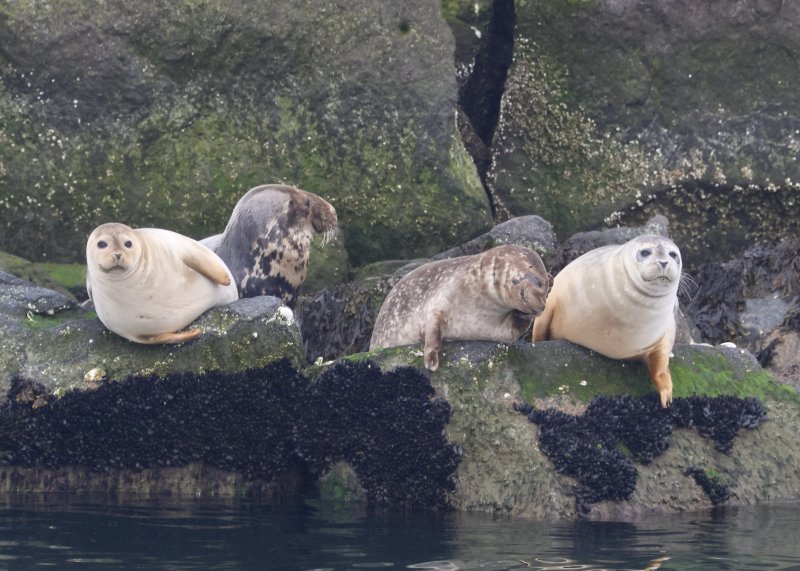
Our trip was a success! Close to the waterline, every nook and crevice in the rock wall was used as a lounger for a seal! Languid seals of all sizes were stretched out soaking up the late-afternoon sun. Reds, tans, grays and Dalmatian-patterned fur dotted the breakwater. Some harbor seals were in the banana pose with their head and back flippers elevated, while others leaned toward the water and casually rolled into the sea. Out on the stacked rocks, large gray seals lined up like sunbathers on a crowded summer day. Heat loss is rapid in cold waters, so sunning on warm rocks may be vital to survival! Phocids have only a single layer of dense fur against their skin to trap air. To maintain a warm body temperature, seals have a thick layer of blubber for insulation. Research suggests that gray seals accumulate a layer of fat between 6 and 10 cm thick. That is pinching almost 2 to 4 inches! The diminutive harbor seal weighs in between 100 and 300 pounds with about 30% being blubber. Great for floating, too!
While it is unusual (but always possible) to encounter a seal sunbathing on our Lewes beaches during the winter, dozens of seals congregate closest to Delaware Bay on the outer breakwater and ice piers, locally called the “haystacks.” On land or at sea, please maintain a respectful distance of at least 150 feet from a seal. The MERR Institute, based in Lewes and celebrating over 25 years of service, is a nonprofit stranding response and rehabilitation organization dedicated to the conservation of marine mammals and sea turtles. For more information or to report a stranding, go to merrinstitute.org.
-

Wild Cape is a monthly column by Alice Mohrman dedicated to the rich and diverse ecosystem of Delaware’s Cape Region. It is our hope to bring readers closer to the natural world by exploring fascinating creatures, plants and habitats that thrive in one of the most ecologically significant areas of the Mid-Atlantic.