












Highland Heights fate in Lewes City Council's hands
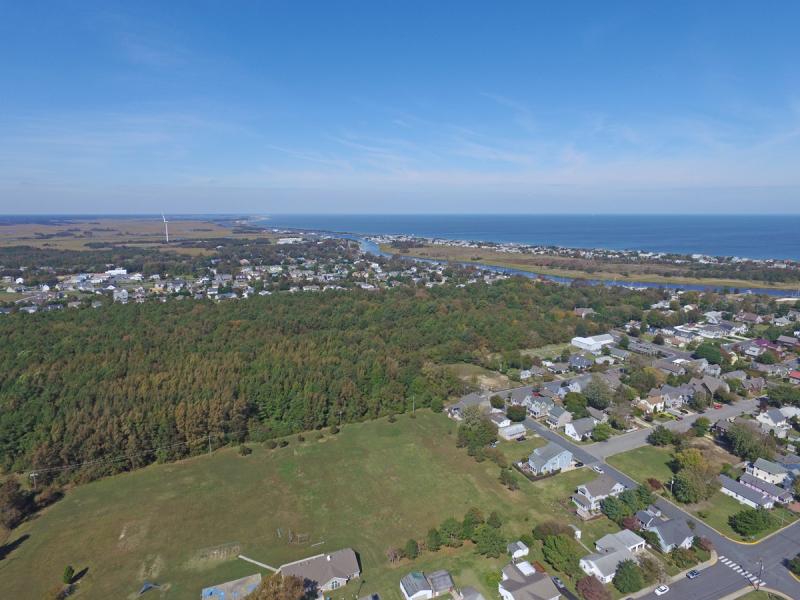

The long-awaited final decision for the proposed Highland Heights subdivision in Lewes' Fourth Street Forest is now in the hands of mayor and city council.
Jack Lingo Asset Management is seeking approval of a plan to build 34 single-family homes on 18.34 acres between West Fourth Street and Seagull Drive.
Jack Lingo officials have been navigating the city's subdivision approval process since August 2013. In January, the planning commission voted 6-3 to recommend to city council that the application be denied because it did not meet the requirements of city code.
City council held a public hearing April 4, drawing a crowd too large for council chambers. Many residents who spoke advised council to trust the commission and affirm its recommendation.
“You were the ones who selected the commission, and they came back with a vast majority opposing the development,” resident Tom Bell told council. “You ought to think about that.”
The record will remain open until 4 p.m., Friday, April 8. City Solicitor Glenn Mandalas said there is no specific time table set forth in city code for council to make a decision, however, he said, it is in council's best interest to make a decision in a timely manner. He said council has options available, including approving the plan as presented by the developer, denying it or sending it back to the planning commission.
Nick Hammonds, principal at Jack Lingo Asset Management, said the application has met all requirements, including the 12 conditions added by the planning commission as part of preliminary consent approval.
Two conditions, specifically, have been the topic of discussion. One urged the developer to remove the plan's cul-de-sacs, while the other suggested the developer consider establishing a bike and pedestrian connection to the Highland Acres community to the east.
Neither of the conditions were firm requirements, and Hammonds provided reasons for why he and his team chose not to change the plan.
The existing plan shows two entrances to the community, one from West Fourth Street accessing 20 homes and the other from Seagull Drive accessing 14. The two ends of the community would not be connected for vehicular traffic. Hammonds said issues, including public safety concerns, led to his team's decision to stick with cul-de-sacs. He provided a petition signed by about 250 residents of neighboring Pilottown Village and other nearby communities who are opposed to a through street in Highland Heights.
“There are no sidewalks within [Pilottown Village], so you'd be putting potentially a bunch of additional traffic on the streets with pedestrians and bicyclists who are already on the roads,” Hammonds said.
Connecting the two sides of the development would reduce the area available for stormwater management and wetland protection buffers, he said. It would also create a stretch of road without any lot frontage, adding maintenance costs to the city without lot owners to pay for that maintenance.
Similar to the cul-de-sac/ through street issue, Hammonds said, there was overwhelming opposition from Highland Acres residents to include a pedestrian and bicycle connection to Highland Heights.
Like Pilottown Village, he said, Highland Acres also does not have sidewalks, which could create public safety issues.
Hammonds also addressed tree removal, which became a hot topic recently before the planning commission. He said tree preservation is of utmost importance and an effort would be made to save as many trees as possible.
“From a developer's perspective, projects are more attractive and far more saleable when they have trees,” he said. “Lots are more valuable when there is good specimen-tree coverage. Mature trees are a big selling point.”
Tree removal is necessary, he said. Subdivision design starts with stormwater and ensuring proper drainage can be accommodated. Tree cutting and lot fill is likely needed to properly grade the property. Trees are also lost for streets and utilities, and those within a building footprint would also be removed.
Jack Lingo Asset Management hired Parker Forestry Service Inc., certified through the Society of American Foresters, to study the property. The company found the property was open land until 40 years ago, when it began to grow over with trees, vines and shrubs. The company found the site is stocked with a mixture of hardwood species and loblolly pines and that a significant number of nonnative, invasive species are present.
To ensure satisfactory stormwater management on the site, Hammonds said, a plan has been developed to fix a faulty tax ditch existing on the site. The repairs will be made at no cost to Lewes residents as part of the project, he said.
With all requirements met from his perspective, Hammonds said, the plan should be approved.
“The application before the city was submitted in accordance with the city’s zoning designation for this property of R-2,” said Hammonds in an email. “Simply put, the project has met or exceeded all requirements for approval.”
In addition to meeting all requirements, Hammonds said, approval of the subdivision would have a significant financial impact on the city. Transfer taxes, impact fees and building permits, among others, would result in more than $560,000 of revenue to the city in one-time fees. Annual revenue realized from Highland Heights is about $78,000, the company has estimated.
Residents continue opposition
Several residents continued to voice their opposition to the project, with many citing the loss of one of the city's final forested areas as a top concern.
“We are a tree city,” said resident Janice Pinto. “We were voted the Most Beautiful Small City in America, and our last forest fragment in Lewes, the Fourth Street Forest, is part of it. This area begs to be saved for us, the citizens of Lewes.”
She continued, “Future generations of Lewes citizens will want to know what we did to help save the last fragment of forest in Lewes,” she said. “It's not good enough to deforest an area and then landscape with 6-foot crepe myrtles. This is an opportunity for us to do what is right for the city of Lewes.”
Chet Poslusny, who lives in a Gills Neck Road community, said he fears the Highland Heights property will be treated as the Showfield property was.
“I took pictures every day as the large amount of trees were destroyed,” he said. “They followed all the regulations and requirements in place in the county, and they were allowed to do that. Had they taken the time to account for the trees and saved as many as possible that made sense, it would've been much better, but they didn't.”
Ann Nolan, who owns a home near the proposed site, said city council should deny the project because it will have adverse effects on the value of nearby homes.
“You are obligated to consider the effect on area property values. Once you cut down most of those trees – and they will mostly be cut down – and add fill dirt necessary to build upon wetlands, the trees left standing will die,” she said. “The inferior plan being presented to us takes no consideration of the surrounding properties and the damage it will cost. The plan smacks of greed and avarice and should be rejected.”
Elizabeth Owen urged council to deny the request.
“I'm suggesting the evidence is clear,” she said. “The decision by the planning commission to recommend city council deny the request … is based on sound facts relating to wetland protection, connectivity and safety.”

Nick Roth is the news editor. He has been with the Cape Gazette since 2012, previously covering town beats in Milton and Lewes. In addition to serving on the editorial board and handling page layout, Nick is responsible for the weekly Delaware History in Photographs feature and enjoys writing stories about the Cape Region’s history. Prior to the Cape Gazette, Nick worked for the Delmarva Media Group, including the Delaware Wave, Delaware Coast Press and Salisbury Daily Times. He also contributed to The News Journal. Originally from Boyertown, Pa., Nick attended Shippensburg University in central Pennsylvania, graduating in 2007 with a bachelor’s degree in journalism. He’s won several MDDC awards during his career for both writing and photography. In his free time, he enjoys golfing, going to the beach with his family and cheering for Philadelphia sports teams.