












Dewey to move forward with climate change resiliency plan
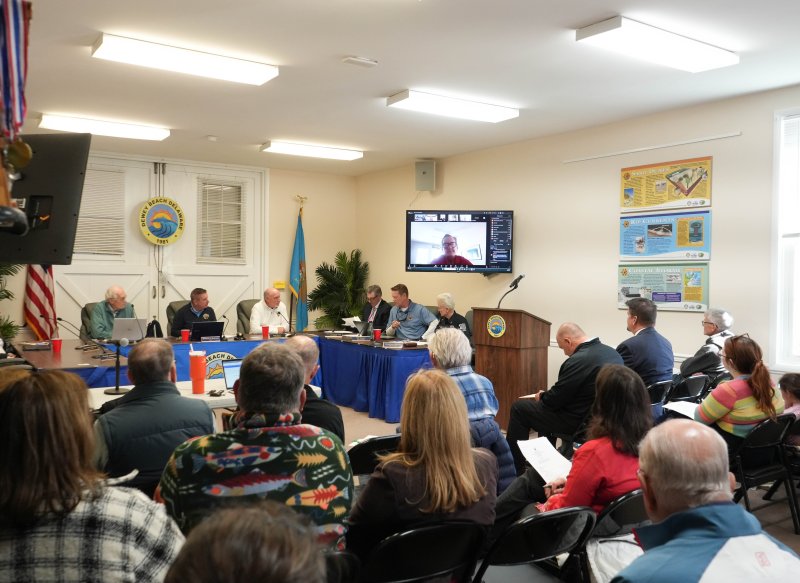
Dewey Beach Town Council voted to move forward with a $75,000 climate change resiliency plan at its March 20 meeting. It also approved ordinances relating to building permits for maintenance projects on commercial properties and tree requirements for construction projects.
The resiliency plan was presented by Debra Phillips-Goldenberg, chair of the town’s resiliency & sustainability committee.
It lays out the framework for a study to evaluate the town’s vulnerabilities to flooding, sea-level rise and other climate change-related risks, thus allowing the town to better anticipate, withstand and recover from these hazards. The study is estimated to take 10 months to complete.
“The town cannot afford to piecemeal projects with guesswork to address issues as they arise,” Phillips-Goldenberg said. “[It] needs a comprehensive plan that updates prior studies so that we can get ahead of what would otherwise be the likely damaging outcome of storms and flooding that we know we are going to have.”
The last comprehensive study for the town was performed nearly 10 years ago.
“I think it’s important for us to stay ahead of the game, because flooding is the biggest risk that Dewey has going forward,” Mayor Bill Stevens said. “It’s not going away, and we need to address it.”
The plan was developed with the help of Brent Jett, an associate, project manager and coastal resiliency group leader at engineering design firm George, Miles & Buhr. The town selected GMB to be the contractor for the project, per the committee’s recommendations.
Now that the plan has council’s approval, it will be sent to the infrastructure committee to review and decide whether to permit the use of town infrastructure funds to pay for it.
Permits for commercial maintenance
Council approved an ordinance to amend town code to specify conditions for which building permits and fees are not required for maintenance on commercial properties.
The amendment comes just a few months after council passed the original ordinance, which aims to simplify the permitting and approval process for maintenance projects, in December 2025. Read more at tinyurl.com/nfd7n6ez.
That original ordinance, which went into effect April 1, the first day of Fiscal Year 2027, defines maintenance activities and establishes, among other things, that intermediate maintenance – maintenance that costs between $1,000 and $10,000 – does not require a building permit or fee, provided that notification of such work is provided to the town building official. The maintenance may proceed only upon approval by said official.
However, the town received comments from a number of businesses that took issue with this, said Commissioner Gary Persinger.
“It seemed clear that the procedure we had specified for notifying that such residential work was going to be undertaken would be a burdensome, unmanageable process for commercial properties here in town,” Persinger said.
The amended ordinance aims to ease the process for businesses by making it so that prior approval from the building official is necessary for intermediate maintenance on residential properties only, not commercial properties.
In other words, businesses won’t need to wait for approval to proceed with such maintenance.
However, by the 15th of each month, commercial properties must submit a report of all intermediate maintenance projects from the previous month to the town, listing for each project a description of the maintenance activity and information substantiating the total cost, including labor and materials, of the work.
This makes it easier for businesses, allowing them to submit a month’s worth of projects all at once instead of individually, while still ensuring the town can keep accurate records of the work happening.
Tree requirements
Council approved an ordinance that establishes a minimum number of trees required per square footage for new construction of, or additions to, single-family detached dwellings in three zoning districts.
The ordinance aims to preserve and enhance the town’s tree canopy and overall green space
The districts, along with their minimum requirements, are as follows: Neighborhood Residential – one tree per 1,666 square feet; Resort Residential – one tree per 2,000 square feet; and Resort Business – one tree per 2,500 square feet.
When calculating the number of trees, if the product has a decimal greater than or equal to 0.5, round up a tree; if it has a decimal less than 0.5, round down. For example, a typical 5,000-square-foot lot in the RR district requires 2.5 trees, which would be rounded up to three trees.
The trees planted to meet these requirements must also satisfy the existing native species and size requirements outlined in the town code.
To access any of the documents discussed during the meeting or for a link to the meeting recording, go to townofdeweybeach.gov/events/42903/.

Ellen McIntyre is a reporter covering education and all things Dewey Beach. She graduated with a bachelor’s degree in journalism from Penn State - Schreyer Honors College in May 2024, then completed an internship writing for the Pittsburgh Post-Gazette. In 2023, she covered the Women’s World Cup in New Zealand as a freelancer for the Associated Press and saw her work published by outlets including The Washington Post and Fox Sports. Her variety of reporting experience covers crime and courts, investigations, politics and the arts. As a Hockessin, Delaware native, Ellen is happy to be back in her home state, though she enjoys traveling and learning about new cultures. She also loves live music, reading, hiking and spending time in nature.