













Spring peeper chorus is an ode to freshwater wetlands
Oh, the sweet sounds of spring. A high-pitched “fried rice, fried rice” frog chorus highlights my evening commute. As fields yield to puddles and woodlots edge ponds, the musical crescendo rises and falls across our Cape Region. The collective calls of many male spring peepers boldly announce a warming trend! Itching to explore, I jump into my old sneakers and grab a net.
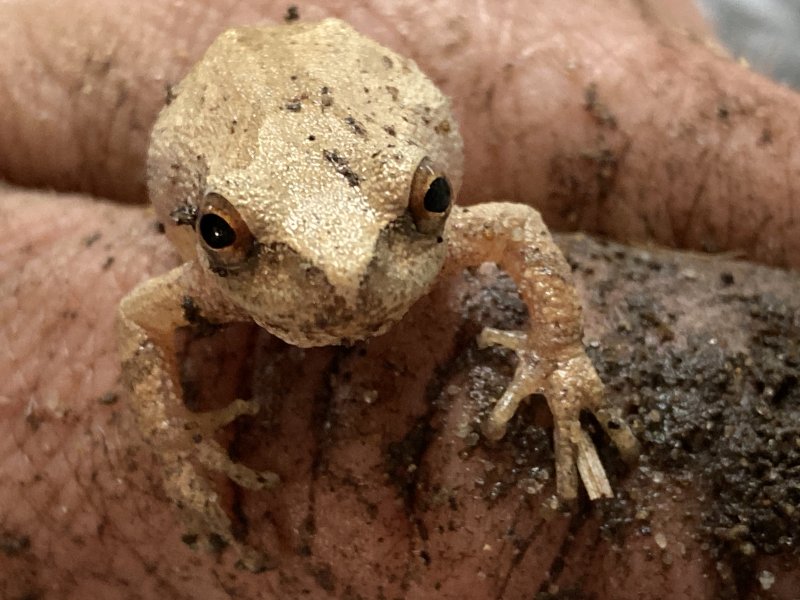
Plotting to catch an inattentive spring peeper (Pseudacris crucifer), I look around the wet brown leaves closest to a freshwater puddle. Vocal at night and silent by day, spring peepers are small! Adults are about 1 to 1.5 inches from nose to vent (body length) and weigh just over one-tenth of an ounce. Imagine the weight of two paper clips! Now, with size in mind, I’m looking for an amphibian sporting a camouflage color palette. Individuals may be various shades of green, olive, tan or brown highlighted with a distinct “X” shape on the back. These frogs often sit motionless, their large golden eyes masked by a wide, dark eye line. Twirl an old leaf by its stalk. Peepers also have dark bands on their pale legs, which coincidentally may match the width of a blade of grass or a leaf petiole (stalk).
Have you memorized all the color possibilities? Have you just spotted a dark peeper jumping from the shade to a sunny sphagnum moss? This tiny frog species has “dynamic coloration”! In about 40 minutes, a peeper has the ability to completely change color based on substrate, moisture levels and light conditions. In an article titled Small Wonders: How to Be a Spring Peeper (March 2026), Maine Audubon field naturalist Stacia Brezinski writes that spring peepers are inclined to choose “visual textures and usually settle themselves on top of a stripe when available” during lab experiments. “The preference for variegated surfaces puts those ‘X’ markings to work, breaking up the outline of the frog’s body.”
Did I mention quick reflexes? Frogs may seem mellow, but they are always alert. To the surprise of a young naturalist, a peeper under close inspection was airborne in a nanosecond, rocketing upward to 8 inches and maintaining that altitude while moving away from the observer. It “flew,” covering a distance of almost three feet, to land with toes extended on an equally surprised student. Spring peepers were once considered tree frogs because of their large toe pads and ability to climb vegetation. Each toe pad is wide, smooth and flexible, offering the frog maximum contact on uneven surfaces. Glands within the toes secrete a mucus that acts as an adhesive, especially effective on wet surfaces, for climbing.
Quiet and elusive, these amphibians spend most of the year in woodland or shrub habitat, preferring to be close to the ground in the leaf litter. Their diet is based on prey availability and size, but usually consists of slow-moving and crawling animals such as spiders, isopods (pill bugs), and a variety of insects including ants, beetles and mites. Spring rains fill shallow depressions, creating temporary, fish-less vernal pools that become gathering sites for mating peepers. These freshwater puddles offer submerged vegetation for egg development and increase tadpole survival statistics. Unlike other frog species that deposit one large egg mass into the water, a female peeper will spread out her potential progeny, about 800 to 1,200 eggs, over a wide area. She will attach a jelly cluster of one to three eggs to an underwater stem or leaf, completing this process over 400 times! Complete metamorphosis from egg to tadpole to froglet to adult reaches the finish line in July.
Migrating to a nearby puddle, a few hardy male peepers may begin to vocalize as the evening air temperatures reach 40F. Choral membership increases proportionally as temperatures climb. To hear their unique high-pitched peep, visit virginiaherpetologicalsociety.com. Crowds peak as thermometers reach 50 F, with some hot spots supporting hundreds of males, each frog trying to project louder and faster to attract a female. Female peepers do not sing, but they are listening. Males sing in trios. The one that starts the round is usually the largest male with the deepest voice. Each call or peep is amplified by a vocal sac, almost equal to the size of the frog, that expands like a balloon. A male will belt out 20 to 25 high-pitched peeps each minute. That’s 12,000 to 15,000 calls every hour throughout the evening! The mighty spring peeper chorus weaves a lyrical enchantment celebrating our freshwater wetlands.
-

Wild Cape is a monthly column by Alice Mohrman dedicated to the rich and diverse ecosystem of Delaware’s Cape Region. It is our hope to bring readers closer to the natural world by exploring fascinating creatures, plants and habitats that thrive in one of the most ecologically significant areas of the Mid-Atlantic.