












Dewey commissioners approve mini golf
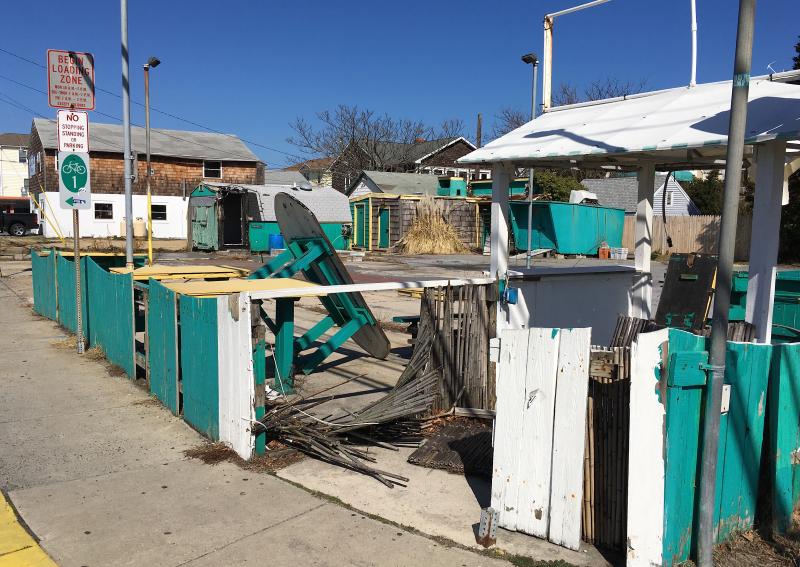
After disagreement over the definition of patron space, Dewey commissioners voted 3-2 May 11 to approve mini golf at the former site of Ed’s Chicken.
At issue was how to measure patron space at Nick Geracimos’ proposed Nick’s Dewey Dino Golf. Town code states an establishment with under 2,000-square-feet of patron space doesn’t require off-street parking.
Geracimos’ attorney Glenn Mandalas said the combined area of all playing surfaces was 1,992½-square-feet. He said the 18 holes are like an 18-table restaurant, which would typically be under 2,000-square-feet and wouldn’t require off-street parking.
Mandalas said he asked Dewey Building Official Bill Mears if the playing surfaces would constitute patron space. He said Mears first told him he would not require off-street parking, then later said he was unsure if parking would be required.
“He said, ‘it could go either way,’ so at least in the mind of the building official, it is a provision within the code that doesn’t have a clear applicability to miniature golf courses,” Mandalas said, citing cases decided in favor of the landlord when zoning is unclear.
“If there’s an off-street parking requirement, there’s no way this project happens,” Mandalas said.
Commissioner Gary Persinger said walking areas within the course should be included within the patron area measurement, as they are within restaurants.
“You can’t play miniature golf unless you can walk between holes,” he said. “If you claim there’s ambiguity within our code, you have to have a basis, a logical argument for your position, and that’s what I’m having trouble with. I’m not finding it.”
Several Swedes Street residents said they had concerns about parking, lighting, fencing and the attractiveness of the dinosaur theme, but generally spoke in favor of the project.
Commissioner David Moskowtiz asked whether a 144-square-foot party area was included within the measured patron space. Mandalas said it was not considered a playing area. Mayor TJ Redefer said commissioners could debate what constitutes patron space until the cows come home.
Persinger objected to not including the party area. “The way you’re structuring this, you’re basically rewriting the code,” Persinger said. “The first sentence in the patron area says ‘that area of a restaurant or commercial establishment open and accessible to customers.’ You’re constructing a definition of patron area that makes absolutely no sense.”
Commissioner Paul Bauer motioned to approve the course with conditions, including the definition of patron space as the course’s playing area. Bauer denied requests by Persinger and Moskowitz to add the course’s party space to the defined patron space.
Persinger then offered an amendment to the motion to include the party area in the patron space definition. Moskowitz seconded the motion, which carried, making the party area part of the patron space definition, now totalling 2,136 ½ square feet and requiring off-street parking.
Town Counsel Fred Townsend said Geracimos would have to then eliminate the party area or redesign the course to bring the patron area under 2,000 square feet.
Bauer said he could amend his motion that the playing area and party area not go over 2,000 square feet. Geracimos said he was confused and didn’t know how to take away space that was there. Town Manager Scott Koenig said Geracimos would have to remove the party area or seek a variance from the board of adjustment.
Persinger said he would approve mini golf if defined patron space included the party area. He asked how to come to a conclusion without forcing the applicant to go before the board of adjustment or redesign the course.
Townsend said commissioners could motion to reconsider including the party area as patron area. Cooke motioned to reconsider the decision that patron space be only the playing area. Redefer, Cooke and Bauer voted to approve; Persinger and Moskowitz voted against, so parking would not be required.
Moskowitz said a party area is part of the patron area for zoning purposes. “Why should this business be an exception?” he asked.
Persinger said he was disturbed that commissioners ignored plain language in the code and speculated on approvals made in the past.
“I don’t think we have bent the language of the code as severely as we did in this case,” he said. “In order to pass this, you had to accept a completely absurd definition of a patron area.”
Conditions included downward-directed lighting, operating hours of 9 a.m. to 11 p.m., perimeter fencing at permissible heights, no alcohol, outside music turned off at 11 p.m., the sale of prepackaged food and beverages but no food prep on-site, and security cameras.