




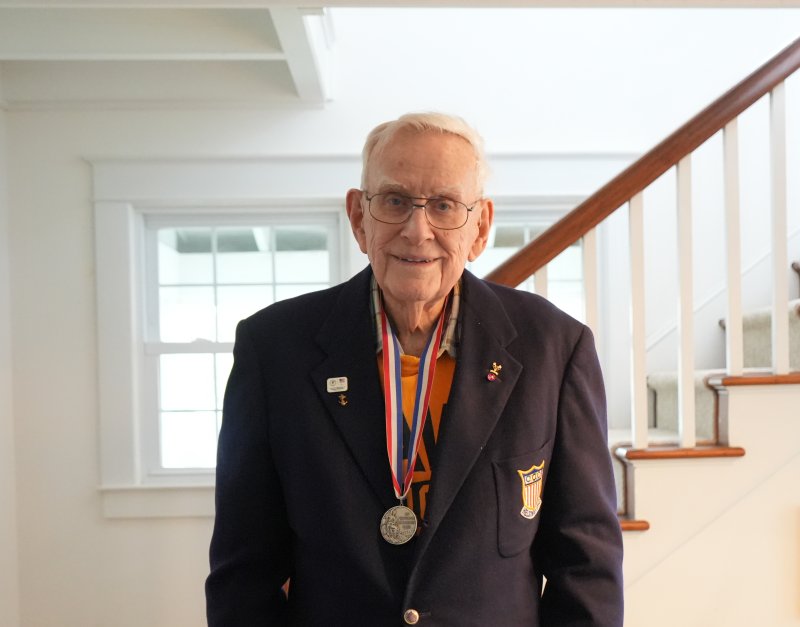
 Frank Shakespeare, 95, the oldest living U.S. Olympic gold medalist, returned to Dewey Beach, where he spent summers growing up, April 20. ELLEN MCINTYRE PHOTOS
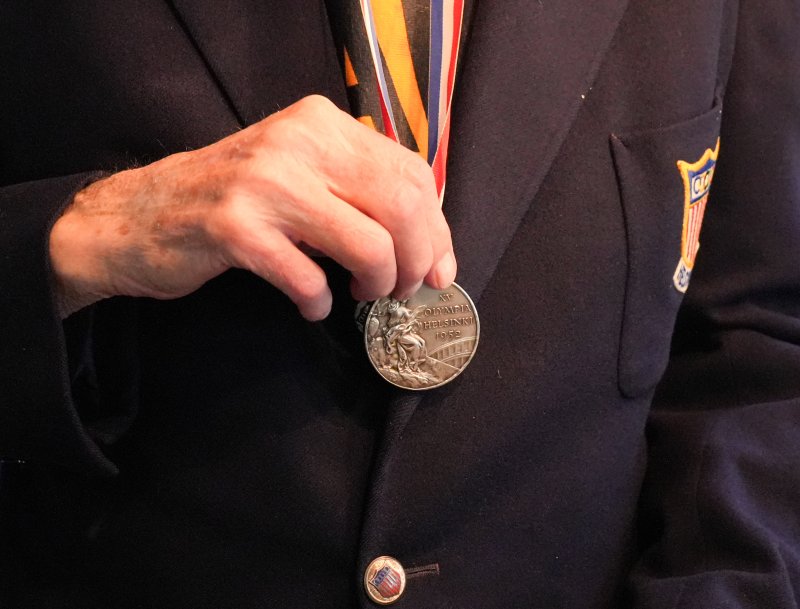 Frank Shakespeare holds his Olympic gold medal from the 1952 Helsinki Olympics. He is also wearing his real Olympic jacket.
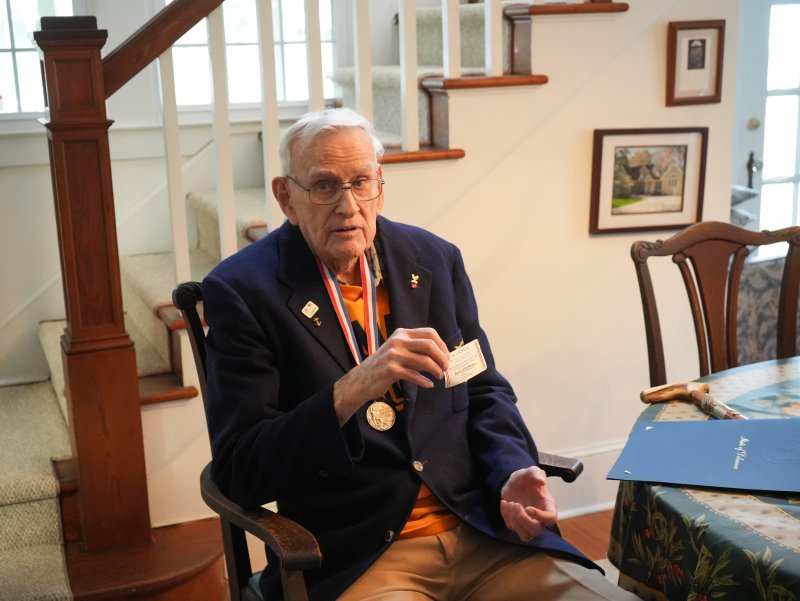 Frank Shakespeare holds up a card with his message to younger generations: “Be a winner. DON’T: Cheat, lie, or do drugs. And don’t blame others. DO: Try hard, be a good team player, do your best and be a friend.”
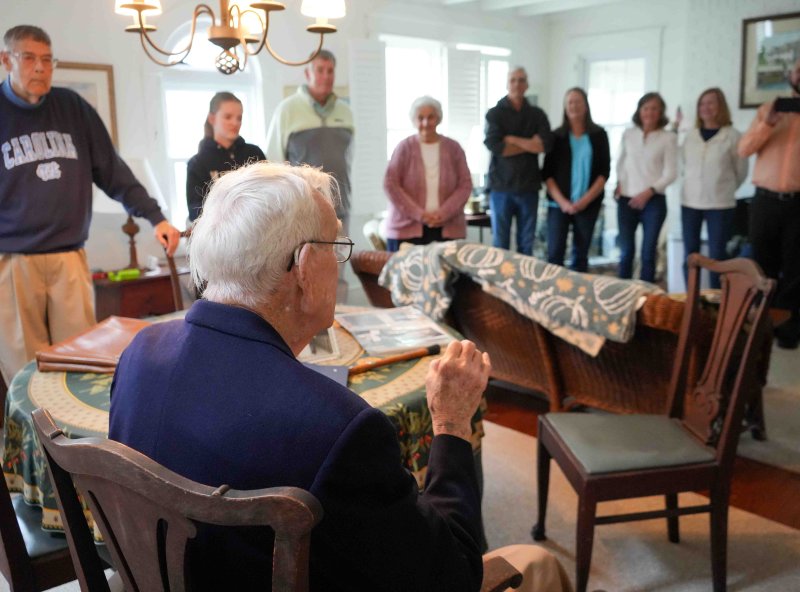 Frank Shakespeare gives a speech to his family and friends during his visit to Dewey Beach.
Frank Shakespeare, 95, the oldest living U.S. Olympic gold medalist, returned to Dewey Beach, where he spent summers growing up, April 20. ELLEN MCINTYRE PHOTOS
Frank Shakespeare holds his Olympic gold medal from the 1952 Helsinki Olympics. He is also wearing his real Olympic jacket.
Frank Shakespeare holds up a card with his message to younger generations: “Be a winner. DON’T: Cheat, lie, or do drugs. And don’t blame others. DO: Try hard, be a good team player, do your best and be a friend.”
Frank Shakespeare gives a speech to his family and friends during his visit to Dewey Beach.
Frank Shakespeare gives a speech to his family and friends during his visit to Dewey Beach.
Frank Shakespeare, 95, the oldest living U.S. Olympic gold medalist, returned to Dewey Beach, where he spent summers growing up, April 20. ELLEN MCINTYRE PHOTOS
Frank Shakespeare holds his Olympic gold medal from the 1952 Helsinki Olympics. He is also wearing his real Olympic jacket.
Frank Shakespeare holds up a card with his message to younger generations: “Be a winner. DON’T: Cheat, lie, or do drugs. And don’t blame others. DO: Try hard, be a good team player, do your best and be a friend.”
Frank Shakespeare gives a speech to his family and friends during his visit to Dewey Beach.
Frank Shakespeare, the oldest living U.S. Olympic gold medalist, fondly remembers the summers he spent growing up swimming, fishing and having fun in Dewey Beach – and how everything changed when World War II started.
“All the boats disappeared,” said Shakespeare, 95, during an April 20 visit back to town, which prompted a formal tribute from Sen. Eric Buckson, R-Dover. “Black cloth went over the windows, all [on] the shore side.”
At dusk, Shakespeare said, the Coast Guard would clear the beaches, and patrol up and down on horseback. There were submarine operations nearby, and ships were sunk by German U-boats along the Delaware coast.
“I remember many a day going swimming out there, coming back with diesel oil up and down my legs,” Shakespeare said. “We had to come up and wash off and take a shower outside.”
On the day the war ended, he was helping his dad cut the grass at his family’s house in Dover, while his brother John was down at the beach with his mom. The boys had a rotating chore schedule, and Frank happened to be the one in charge of helping his dad that day.
“I was so upset I was up in Dover,” Frank said. “The fire trucks were screaming and hollering, ‘The war’s over!’ and my brother was down here walking the boards with some of the other guys.”
Member of the Great Eight
After graduating from Dover High School, Frank attended Columbian Preparatory School in Washington, D.C., and enlisted in the U.S. Marine Corps Reserve.
He trained and drilled as an aviation ordnance technician with the Hell’s Angels of Marine Fighter Squadron VMF-321.
In 1949, he applied for and received an appointment to the U.S. Naval Academy, where he was introduced to rowing for the first time.
All Navy students, including freshmen, or plebes, were required to participate in either intercollegiate or intramural athletics.
Shakespeare tried out for the basketball team but was cut in the final round of tryouts. That’s when a friend suggested he try rowing.
Shakespeare went on to become a member of the Navy men’s rowing team.
In 1951, his sophomore season, all three Navy boats competing in the national championships sank.
Just one year later, the team shocked the nation when it qualified to represent the U.S. in the 1952 Helsinki Olympics after an undefeated season.
The team, known as the Great Eight, defeated the Soviet Union to win gold in the final race of the games.
It was a symbolic victory for the Americans amidst the Cold War, beating the Soviets in their first Olympic Games. The USSR had hoped to prove its Communist superiority through athletic dominance, but the Great Eight frustrated the Soviets' efforts to dominate the overall medal tally.
Immediately following the race, Shakespeare and his teammates were handed their gold medals and a bouquet of flowers as they stood on a pier near the finish line.
“Under everybody’s feet, there was a little puddle of tears,” Shakespeare said, recalling his teammates’ emotions.
After receiving their medals and flowers, the crewmen had to get back into their boat, set their winnings at their feet and row the entire way back to the starting line, where they could get out.
“Yeah, that was upsetting,” Shakespeare laughed.
There was no ribbon or formal medal ceremony on a podium.
Sportsmanship and camaraderie
After the race, the U.S. crew presented their practice shirts to the Soviet crew as a gesture of international goodwill and sportsmanship.
It was the Soviet Union’s first time competing in the Olympics.
That year, there were two Olympic Villages: one for the Soviets and their Eastern Bloc allies – Hungary, Poland, Bulgaria, Romania and Czechoslovakia – and one for everyone else.
The Soviet crewmen were so impressed with the Americans’ sportsmanship, Shakespeare said, that they invited them back to their village for a dinner the following night.
This, Shakespeare said, was a huge moment. The U.S. rowers were the only outsiders to be invited into the Soviet training camp for the dinner, which included a performance by the Bolshoi Ballet.
The dinner came back to haunt one of Shakespeare’s teammates, Wayne Frye, a couple years later. Frye, who had been nominated as a candidate for the Rhodes Scholarship, was rejected because of his association with the Soviet crew.
A forever bond and lasting impact
Shakespeare and his teammates stayed friends for the rest of their lives, meeting up for several reunions and even rowing together at some of them.
Many continued their commitment to service after the Olympics, pursuing careers in the military and earning various commendations.
Shakespeare went on to serve onboard the USS Des Moines and, after attending submarine school, spent time in the USS Trigger and USS Requin.
He then received instructor duty orders to the Navy’s Combat Information Center school, where he taught air-intercept and anti-air tactics, techniques and procedures. He was later assigned onboard a guided missile destroyer, DDG-5, called the USS Biddle.
Shakespeare was voted Delaware’s Outstanding Athlete in 1953 and was inducted into the Delaware Sports Museum and Hall of Fame in 1982. His crew was elected to the Rowing Hall of Fame in 1954.
In 1992, he and his crew were highlighted in a documentary, “The Great Eight,” narrated by Gregory Peck.
Four years later, Shakespeare carried an Olympic torch for about 1,000 yards in Wilmington during a torch relay for the 1996 Atlanta Summer Games, in recognition of his status at the time as Delaware’s only Olympic champion and only living Olympic medalist.
He is the last of his teammates still alive.
Message to younger generations
After Shakespeare’s time serving his country, he became a public school teacher in Baltimore, Md., where he lived with his late wife Shirley and their children.
He has since retired and now resides in McGaheysville, Va., but continues to give presentations to students of all ages.
At the core of each presentation has been this, printed on a small business card that he carries around in his pocket: “Be a winner. DON’T: Cheat, lie, or do drugs. And don’t blame others. DO: Try hard, be a good team player, do your best and be a friend.”
In Buckson’s tribute to Shakespeare, he commended him upon his return to Delaware after many years away, recognizing a lifetime of extraordinary achievement and distinction.
“At the remarkable age of [95], he stands as the oldest living Olympic gold medalist, a testament to a life defined by perseverance, excellence and service,” Buckson said. “His legacy continues to inspire generations both within Delaware and beyond.”
Frank Shakespeare, 95, the oldest living U.S. Olympic gold medalist, returned to Dewey Beach, where he spent summers growing up, April 20. ELLEN MCINTYRE PHOTOS
Frank Shakespeare holds his Olympic gold medal from the 1952 Helsinki Olympics. He is also wearing his real Olympic jacket.
Frank Shakespeare holds up a card with his message to younger generations: “Be a winner. DON’T: Cheat, lie, or do drugs. And don’t blame others. DO: Try hard, be a good team player, do your best and be a friend.”
Frank Shakespeare gives a speech to his family and friends during his visit to Dewey Beach. Event Details :


Premier Listing
Sponsored Content



















Premier Listing
Sponsored Content

In the Market
Sponsored Content
Real Estate Marketplace
Sponsored Content