




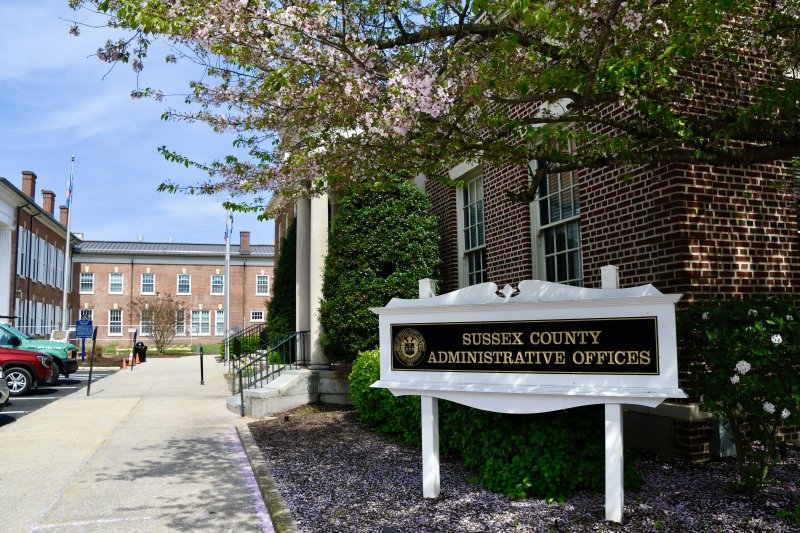
 A $300 million draft budget for Sussex County's Fiscal Year 2027 holds the tax rate steady while initiating fees to help fund public school expansion projects and increasing support for fire departments. FILE PHOTO
A $300 million draft budget for Sussex County's Fiscal Year 2027 holds the tax rate steady while initiating fees to help fund public school expansion projects and increasing support for fire departments. FILE PHOTO
A $300 million draft budget for Sussex County's Fiscal Year 2027 holds the tax rate steady while initiating fees to help fund public school expansion projects and increasing support for fire departments. FILE PHOTO
A $300 million draft budget for Sussex County's Fiscal Year 2027 holds the tax rate steady while initiating fees to help fund public school expansion projects and increasing support for fire departments.
Sussex County Council reviewed the budget at a May 5 meeting.
Finance Director Gina Jennings led much of the budget presentation, followed by department heads who explained their proposed spending plans.
The budget ordinance will be introduced at council’s Tuesday, May 19, meeting and a public hearing is expected to be held Tuesday, June 16. The deadline to approve the budget is Tuesday, June 30.
The budget proposal is up 5.2% from the $285 million FY 26 budget. The tax rate per $100 of assessed property value is projected at 2.15 cents, the same rate set last year after a countywide assessment update.
Jennings cautioned council members that a steady decline in home sales is decreasing realty transfer tax revenue, continuing a five-year trend. Annual revenue is down from a peak of more than $60 million in 2023 to less than $40 million in 2027.
Much of the sales volume is new home construction, which is slowing. The number of building permits for residential units dropped from 4,000 in FY 21 to a projected 2,300 in FY 26. Large apartment buildings are not included in the figures.
Jennings said she is conservative in projecting realty transfer tax revenue because it is unpredictable.
The county would use $12.8 million in reserve funds to hold taxes steady, up 14.5% from the previous year.
“I am not able to balance the budget without reserves,” Jennings said.
The county maintains the equivalent of 25% of its operating budget in reserves, she said.
It is already close to the point that reductions in reserves could jeopardize the county’s AAA bond rating, which now allows it to borrow for capital projects at favorable rates that save money on interest, she said
If current trends continue, the county will deplete its reserves in eight years, Jennings said.
Council members debated how and when to begin addressing the issue.
Councilwoman Jane Gruenebaum was concerned about the county’s reliance on realty transfer tax.
“I don’t think we can budget on wishes and hopes,” Gruenebaum said.
The county should consider spending cuts or other options, not necessarily tax hikes, she said. Incremental changes would soften the blow on taxpayers.
Councilman John Rieley said reserve funds came from property owners and he finds it difficult to raise their taxes when the county is sitting on substantial reserves they funded. He suggested that reserves continue to be used to balance the budget, at least for the time being.
County Administrator Todd Lawson said council has had similar discussion at budget time for at least 15 years, with no action taken to change.
Meanwhile, expenses are rising, including a 10% increase in insurance and a 3% cost-of-living increase for employees. The county plans to consider changes in insurance for its retirees that will provide the same benefits but cut costs by $1 million, Jennings said. A committee of retirees will help review the option, she said.
The planned school surcharge on building permits would be $5 for each $1,000 of construction value for permits for work costing more than $60,000. The county would set aside funds in an account for each district to be used for expansion projects to accommodate overcrowding.
The fee is projected to generate $7.6 million annually, but the figure will be tied to building permit fees paid each year. This will help districts pay the local share of applicable construction projects that would also receive state aid.
In response to a countywide review of fire departments’ finances mandated by the state, the county included in the budget nearly $2 million to hire a firm to coordinate billing for ambulance services and establish a program to help buy ambulances. The money is in the grants-in-aid portion of the budget.
Funding will come from realty transfer tax revenue. This is in addition to the $6 million in aid the county provides fire departments annually.
The county will increase code enforcement fees so they cover the county’s cost to provide the service, Jennings said. The county has gradually been falling behind. After almost breaking even in 2023, the fees covered 92.6% of costs this year.
Revenue will be boosted by several new fees for work that in the past was provided to the applicant without a commensurate charge.
Among the highlights of budget discussions:
-
The county will again pay $2 million for farmland preservation and $417,000 to the Sussex County Land Trust
-
Significant wastewater and water system improvements will continue
-
Sewer service charges for customers will increase 10% to $388 annually per equivalent dwelling unit (equal to a single-family home). Water service charges rise 20% to $540 per year. Jennings said water rates had not been keeping up with costs for years. There are additional fees that vary in different sections of the systems. Water and sewer are billed quarterly
-
While the independent libraries in Sussex County requested an increase in the library tax, no change was included in the draft budget.
A $300 million draft budget for Sussex County's Fiscal Year 2027 holds the tax rate steady while initiating fees to help fund public school expansion projects and increasing support for fire departments. FILE PHOTOEvent Details :
Premier Listing
Sponsored Content















Premier Listing
Sponsored Content

Real Estate Marketplace
Sponsored Content


In the Market
Sponsored Content